
Category: Regional Anaesthesia
-
Axillary Brachial Plexus
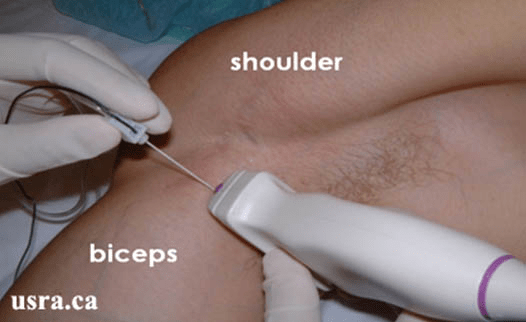
Resources suggested by Dr Pietersen, thankyou. Starting with @KiJinnChin : Considerable anatomic variation is noted for all the terminal branches of the brachial plexus; however the most common orientations are: Median Nerve – anterior lateral to the artery (above and slightly left, at the 10 to 12 o’clock position relative to the artery) Ulnar Nerve…
-
Spine ultrasound
Training on imaging the spine with a view to ultrasound assisted central neuraxial procedures will continue in person intermittently in Raigmore. An example of a video to watch before practicing scanning the spine is here: https://www.youtube.com/watch?v=8_k2I774klo Most people use a curvilinear probe set to a depth of 9 – 11 cm and most do not…
-
Hip analgesia
You all know how to perform a fascia iliaca plane block. A common inguinal approach is described here: Ultrasound-Guided Fascia Iliaca Nerve Block – NYSORA Here’s the Suprainguinal approach sometimes called SIFI How I Do It: Suprainguinal Fascia Iliaca Block (asra.com) which I’m sure some of you are familiar with The Peng block shows promise…
-
Regional Anaesthesia Techniques
The level of independence required – suggested in the Royal College Curriculum – by the end of Stage 1 training is documented for specific procedures here: Stage 1 practical procedures (with supervision levels) | The Royal College of Anaesthetists (rcoa.ac.uk) This includes notably – Ultrasound guided chest wall plane blocks, abdominal wall plane block, lower…
-
Knee Packages
How I Do It: Infiltration Between Popliteal Artery and Capsule of Knee (iPACK) (asra.com) Above is a nice summary of how this man, Dr Sinha – positions people such that he can perform an adductor canal block and move on to an iPACK. (infiltration between Popliteal Artery and Capsule of the Knee) This is part…
 Training in Anaesthesia Highlands of Scotland